Drawing Games for Kids: Vocabulary Building and Creative Play
How teachers and parents use visual drawing prompts to strengthen reading comprehension, vocabulary, and active participation.
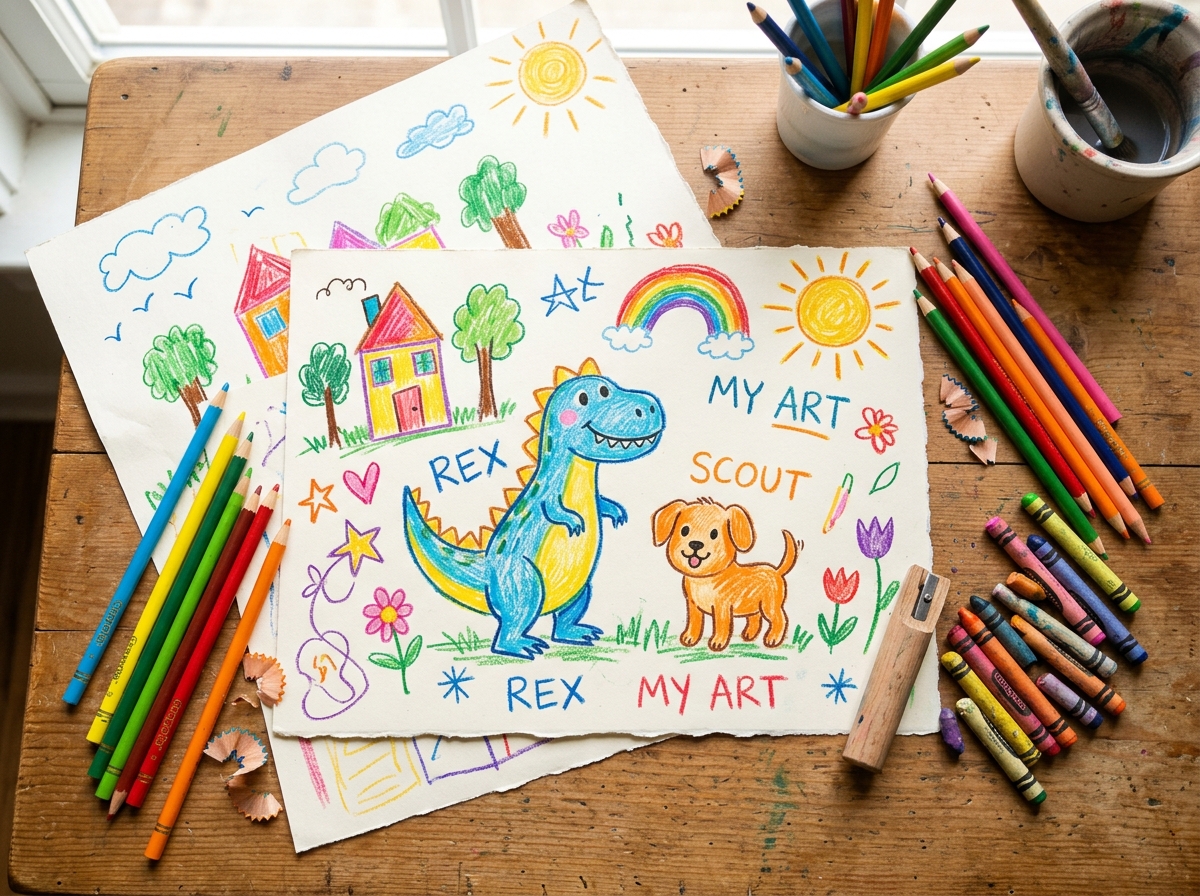
Drawing is one of the most natural forms of human expression, predating written language by millennia. In elementary classrooms and home-schooling environments, sketching games like Pictionary serve as high-retention vocabulary reinforcement.
Why Visual Guessing Accelerates Learning
When a child draws a concept, their brain engages three simultaneous pathways:
- Motor: Physically moving the hand to construct proportion and shape.
- Visual: Comparing mental imagery against the drawing in real time.
- Semantic: Associating the visual essence with the vocabulary term.
Pairing a word with a picture gives children another way to connect meaning with memory. It can make a vocabulary activity more active and conversational than simply reading a list aloud.
Recommended Age Adjustments
- Ages 5 to 7 (Kindergarten – 1st Grade): Use concrete nouns (Dog, Apple, House, Sun). Allow verbal clues if the artist gets stuck after 30 seconds.
- Ages 8 to 10 (2nd – 4th Grade): Introduce simple compound words (Sunflower, Treehouse, Goldfish) and action verbs (Jumping, Swimming, Sleeping).
- Ages 11+ (Middle School): Bring in multi-word phrases and thematic science or history prompts (Volcano erupting, Fossil excavation).
Classroom Setup Tips
- Split the class into 3-4 small groups rather than one giant circle so every student gets a turn.
- Use mini individual whiteboards with dry-erase markers.
- Use our “For Kids” filter which guarantees age-appropriate, wholesome words.
Choose Prompts That Match Children’s Experience
The most useful prompt list is built around words children can understand and imagine. Familiar animals, foods, toys, transport, weather, and places are reliable starting points. A child who knows what a bicycle looks like can draw two wheels, a frame, and handlebars. A child who has seen a rainbow can use a curved set of bands and a cloud. These familiar objects let the game focus on communication rather than explaining the word before the turn begins.
For a mixed group, prepare a few levels instead of assuming every child of the same age has the same vocabulary. Some children may know a wide range of animals but find action words difficult. Others may enjoy drawing scenes but need help reading longer prompts. Let the teacher or parent choose a suitable card, or offer two choices and allow the child to select one. A small amount of choice can make a new player feel more comfortable.
Practical Prompt Ideas for a Kids’ Game
Use concrete words for an introductory round:
- Apple
- Butterfly
- Ball
- School bus
- Toothbrush
- Rainbow
- Teddy bear
- Ice cream
- Kite
- House
- Fish
- Flower
When children understand the rules, add simple actions and short phrases:
- A dog chasing a ball
- A child flying a kite
- A bird building a nest
- A baker making a cake
- A frog jumping on a lily pad
- A family having a picnic
- A snowman wearing a hat
- A train crossing a bridge
- A rabbit eating a carrot
- A boat sailing on a lake
Older or more confident players can try slightly more complex ideas such as a volcano erupting, a firefighter climbing a ladder, a robot watering plants, or a penguin sliding down a snowy hill. These phrases give the artist more than one possible clue while remaining based on familiar objects and actions.
Set Up a Classroom Game Without Long Waiting Times
A whole-class game can become slow if only one child draws while everyone else waits. Divide the class into small teams or stations so several students can participate at once. Each group can use a mini whiteboard, paper pad, or reusable drawing surface. Rotate the artist after each prompt and make sure the role of guesser is shared as well.
Explain the rules in a short demonstration before starting. Show one example of a drawing that uses shapes and another that gives away the answer with letters. Ask students which one follows the drawing-only rule. Keep the explanation simple: draw the idea, do not write the word, and let the team guess. If your classroom uses a modified version with verbal clues, explain that variation clearly so every group follows the same expectations.
A short activity can fit into a lesson warm-up or end-of-class review. Set a clear number of rounds, keep the timer visible, and stop while students are still interested. If the class is large, have groups record their own points rather than asking one person to track every answer. The teacher can move between groups to encourage participation and help resolve unclear prompts.
Use Pictionary to Review a Lesson Topic
The game can be adapted to topics students have already studied. After a science unit, choose words such as plant, seed, rain, habitat, or butterfly. After a story, use characters, settings, and important objects that students are allowed to represent. In a geography activity, choose simple landforms or familiar community locations. The drawing should support the learning objective, not replace the lesson itself.
A useful follow-up is to ask the artist what feature they chose to draw and why. Ask the guessers which clue helped them identify the answer. This short reflection encourages children to think about how meaning is communicated visually. It also helps the teacher notice which words were understood and which may need another example or explanation.
For vocabulary practice, invite the class to say the word together after the answer is revealed. Older students can use it in a sentence, name a related word, or sort it into a topic group. Keep these follow-up tasks brief so the game remains playful. The purpose is to create another opportunity to use the vocabulary, not to turn every round into a test.
Support Children Who Are Learning English
Visual prompts can be useful in a language-learning setting because the picture provides context for a spoken word. Begin with familiar nouns and verbs, say the word clearly, and give a simple example sentence after the round. For instance, after a student draws a bicycle, the class might say, “I ride a bicycle.” For an action prompt such as swimming, students can connect the word with a simple picture of a person in water.
Avoid making a child feel embarrassed if they do not know a word. Offer a simpler prompt, allow a partner to help, or explain the meaning after the guess. Some words have different names in different varieties of English, so agree on acceptable alternatives before the activity. A supportive atmosphere is more important than insisting on one exact phrase when the meaning is clear.
Make the Activity Inclusive and Comfortable
Not every child enjoys drawing in front of a group. Offer alternatives such as drawing with a partner, choosing a prompt from two options, or being the team’s first guesser before taking an artist turn. Use large paper and markers that are easy to hold. A child who needs extra time can use a longer round, provided the same adjustment is applied fairly to others in that activity.
Keep feedback specific and encouraging. Instead of saying that a drawing is good or bad, point out the clue that made it understandable: “The wheels helped us guess bicycle” or “The long ears made the rabbit clear.” Do not compare children’s artistic ability. Pictionary is about sharing an idea with pictures, and a simple drawing can be just as effective as a detailed one.
Choose prompts that are suitable for the age group and respectful of different backgrounds. Not every child has visited the same places, played the same sports, or seen the same objects. Familiar classroom, home, nature, and community vocabulary gives more children a fair chance to participate. If you introduce an unfamiliar term, explain it as a learning opportunity rather than treating it as a mistake.
Adjust Scoring and Timing for the Group
A strict timer can create excitement for older children, but it may make younger players anxious. Begin without points while students learn the process. Later, use a short, flexible timer and celebrate successful communication rather than only the fastest team. You can award one point for a correct guess, or simply keep a class tally of how many prompts the group solves together.
If teams compete, make sure the prompts are similar in difficulty. Do not give one team only simple objects and another team a set of abstract phrases. Rotate artists so confident drawers do not take every turn. Allow a pass if a child does not know the word or would rather not draw it. Clear, consistent rules help keep the activity friendly.
Find More Age-Appropriate Word Lists
For a ready-made collection, visit our Pictionary words for kids category and browse the easy Pictionary words list for beginner-friendly ideas. Animal themes are also popular with younger players, so the animal Pictionary words page can provide another focused round. Teachers who want to connect drawing with movement can use the actions and verbs collection.
A successful children’s Pictionary session does not need elaborate equipment or complicated scoring. Choose words children can picture, keep turns moving, give everyone a chance to contribute, and respond positively to different drawing styles. With a little planning, the same activity can work as a family game, a classroom warm-up, or a playful way to revisit vocabulary.